JHJustin Haubrich
All work
  • iOS 15.0 or later
  • Android
  • Web

Avestan Lexicon

The first app to carry the complete Avesta.

No app had ever carried the complete Avesta. Its corpus has been scattered across print editions and university libraries for over a century, and Avestan itself is a liturgical language with no living native speakers. This is the first to hold all of it, aligned line by line, working with no connection at all.

Avestan Lexicon app icon
Price
Free
Corpus
Complete Avesta, a first
Dictionary
Thousands of entries
Data
None collected

Corpus

The complete Avesta, in one place for the first time

Yasna, the Gathas of Zarathustra, Visperad, Vendidad, the Yashts, Khordeh Avesta, and the surviving Fragments. No other app has assembled the full corpus, and here it works entirely offline.
Reading

Three readings, side by side

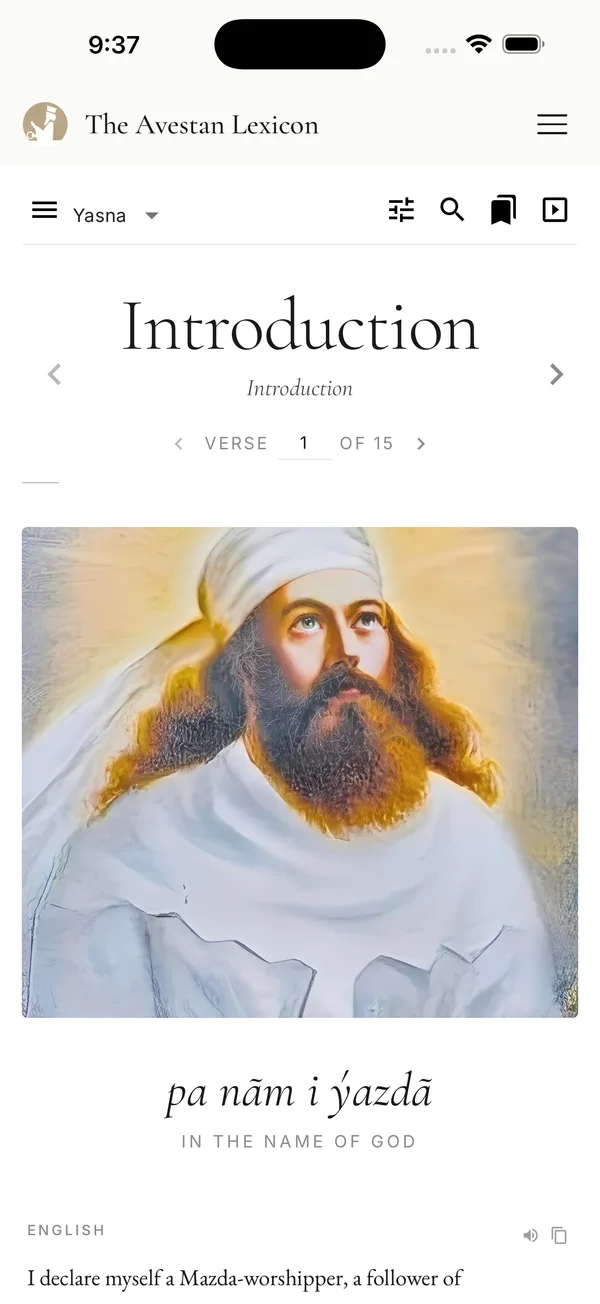
Every verse appears in Roman transliteration, in the original Din Dabireh script, and in English translation at once, so you can move between them without losing your place.

Avestan Lexicon: Three readings, side by side

Dictionary

Tap any word

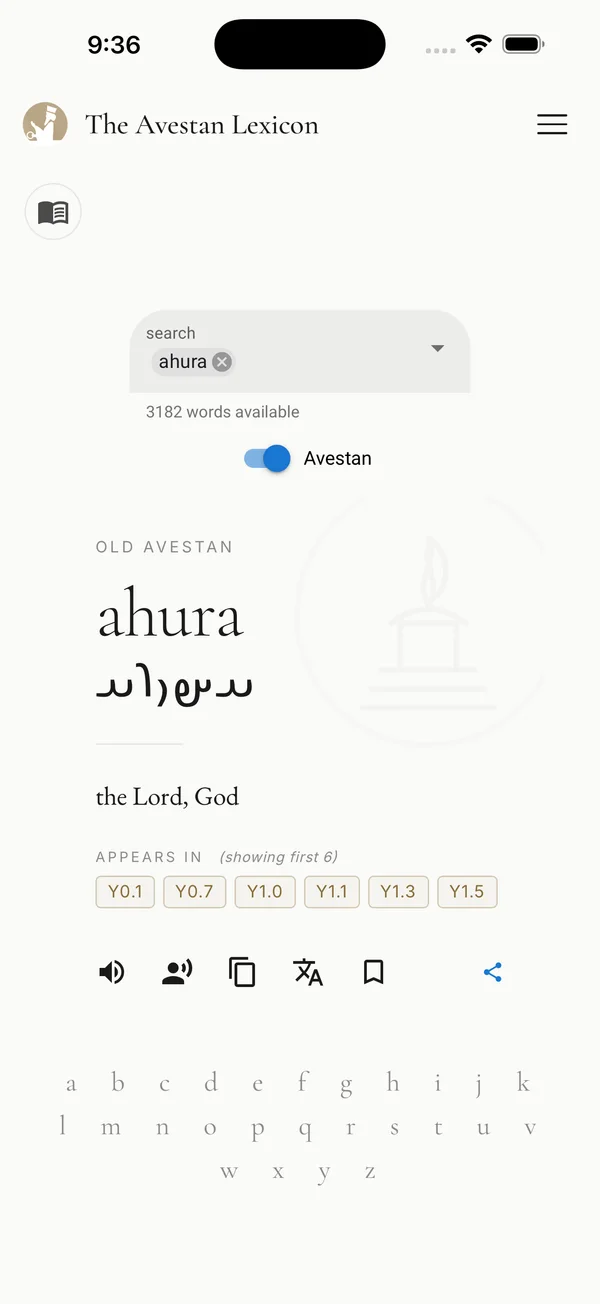
Over three thousand entries with translations, definitions, grammatical notes, and etymological detail. Tap a word inside a verse and its meaning appears immediately, along with every other verse it occurs in.

Avestan Lexicon: Tap any word

Privacy

Built to stay private

The app collects no data. Nothing about what you read leaves your device, because there is no server to send it to.

Under the hood

Why nobody had done this before

The Avesta is not one book. It is a liturgy assembled over centuries, transmitted orally long before it was written, and surviving today only in fragments across manuscripts that disagree with each other. Getting all of it into one app meant solving problems that had kept it in university libraries.

  1. 01

    The corpus is scattered

    Yasna, Visperad, Vendidad, the Yashts, Khordeh Avesta and the surviving Fragments were edited separately, by different scholars, across more than a century of print. No single digital edition held them all.

  2. 02

    Transliteration never standardised

    Different editions romanise the same sounds differently. Aligning them so a reader can move between transliteration, the original Din Dabireh script, and English without losing the verse required normalising all of it to one scheme.

  3. 03

    The language has no living speakers

    Avestan meaning comes from comparative philology, not from asking anyone. Every dictionary entry carries grammatical notes and etymological detail because the reading depends on them.

  4. 04

    It has to work with no connection

    The people who most want this are often reading in a temple or a class, not at a desk. The entire corpus and dictionary ship on-device, which also means nothing about what you read leaves it.

Built with

  • TypeScript
  • Vue
  • Quasar
  • GraphQL
  • MongoDB

Contact

Have something exacting to build?

I take on selective full-stack and native work: secure systems, desktop apps, and data-heavy interfaces. Based in Oklahoma City, working remotely.